Is Enclosed RV Storage Worth the Cost in Texas? A Dallas-Fort Worth Breakeven Analysis
Is Covered RV and Boat Storage Worth the Cost in Texas?
One Storm Away: The Real Cost of RV Storage in the Dallas-Fort Worth Area
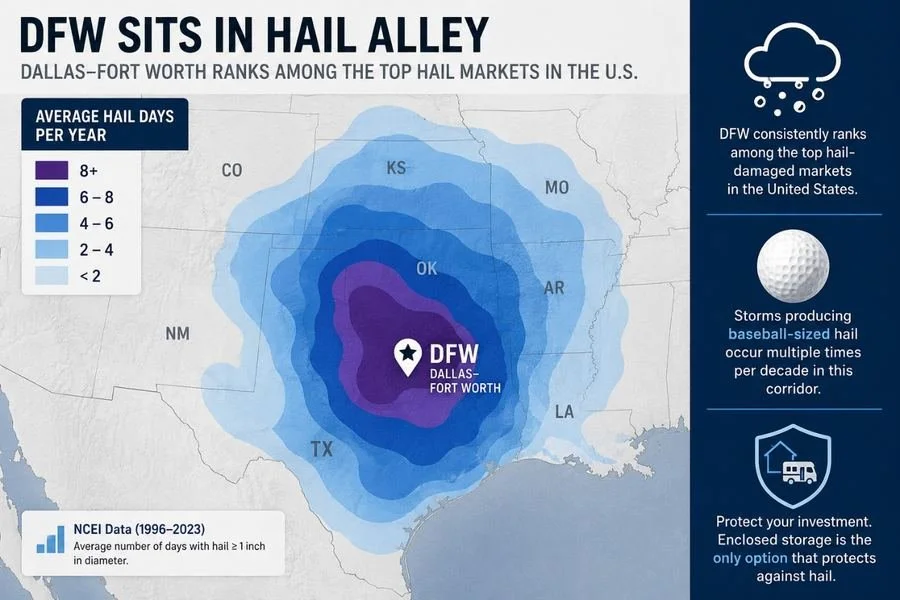
Dallas-Fort Worth sits in what meteorologists call Hail Alley. The metro area consistently ranks among the top hail-damaged markets in the United States. A single severe hailstorm can cause $3,000 to $15,000 in damage to an unprotected RV or boat — the cost of enclosed RV storage for an entire year is often less than the deductible on one hail claim.
Most people choose RV storage based on monthly price. That calculation ignores both the probability and the cost of a single weather event, and it ignores the steady depreciation that happens between storms. This post runs the actual numbers.
In DFW, the math for enclosed storage works out at a lower vehicle value than most people realize. By the time you finish this article, you'll understand exactly where that threshold is and why it's lower in this market than almost anywhere else.
Not sure what your RV or boat is worth?
Check jdpower.com/rvs for RVs, motorhomes, and trailers, or jdpower.com/boats for boats — both free and updated regularly. Cross-check against active listings on rvtrader.com or boattrader.com to see real market prices.
Your vehicle's current value determines which storage option makes financial sense for you.
DFW's Five Threats to a Stored Vehicle
Hail
DFW regularly leads national rankings for hail damage. Storms capable of producing baseball-sized hail occur multiple times per decade in this corridor. Even quarter-sized hail causes dents, cracked plastics, and broken lights. Covered storage with open sides provides no protection against hail — it requires four walls.
Humidity and Moisture
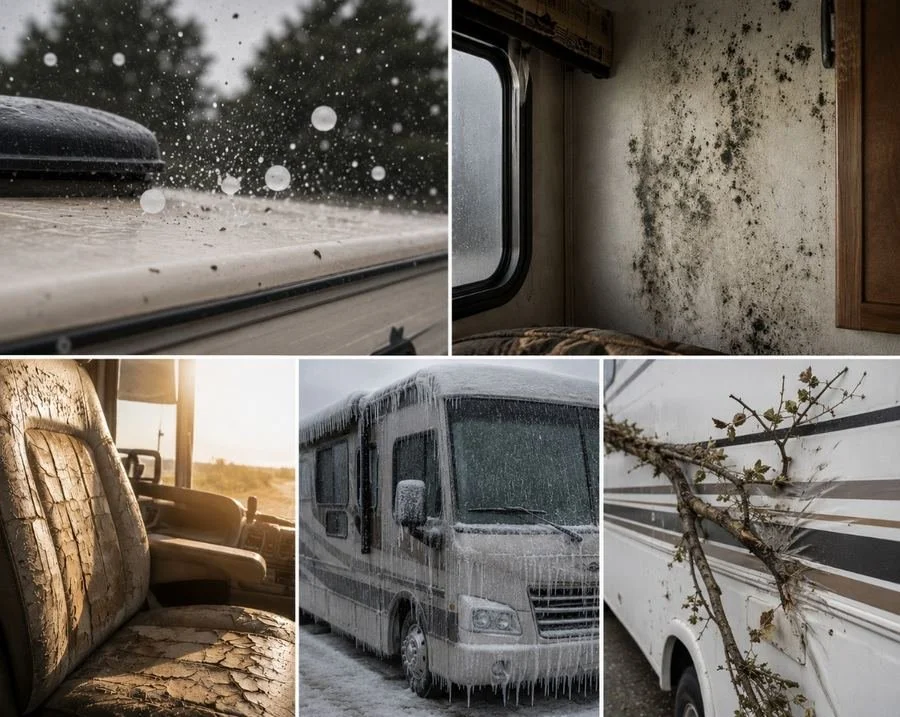
North Texas summers are genuinely humid. Unlike the arid Southwest, moisture here is a year-round concern. It infiltrates through any compromised seal, causes mold inside the vehicle, corrodes metal components, and deteriorates rubber gaskets over time. Humidity damage is cumulative and often invisible until it's expensive.
Summer Heat
DFW summers exceed 100°F regularly, and interior temperatures in a sun-exposed vehicle reach 150°F or higher. This degrades rubber seals, fades upholstery, cracks plastics, shortens battery life, and works roof sealant loose over time.
Ice Storms and Freeze-Thaw Cycles
Texas winters are unpredictable. Freeze-thaw cycles accelerate the failure of sealants, rubber components, and any water that has gotten inside the vehicle. The 2021 winter storm is a reminder that DFW weather extremes aren't limited to summer.
Severe Spring Storms and Wind
Tornado season brings high winds and wind-driven debris to the DFW corridor every spring. Enclosed RV storage is the only option that meaningfully protects against debris impact during severe storms.
How These Threats Translate to Depreciation
Three depreciation rate assumptions apply throughout this article, based on storage type:
- Uncovered: approximately 15% per year
- Covered: approximately 10% per year
- Enclosed: approximately 5% per year
In DFW, hail alone can cause a step-change in value loss that these averages don't fully capture. A single event can add thousands to the effective annual depreciation. The rates above reflect steady-state conditions; they don't include the risk premium of an unprotected vehicle parked in Hail Alley.
Depreciation Rates by Vehicle Type
The table below shows estimated annual depreciation rates by vehicle type, comparing the general market range to DFW-area estimates by storage type. Boats are especially vulnerable to hail damage on hulls, canvas tops, and windshields.
| Vehicle Type | Typical Range | Uncovered (est.) | Covered (est.) | Enclosed (est.) |
|---|---|---|---|---|
| Travel Trailer | 8–12%/yr | 12–15% | 8–10% | 5–7% |
| Fifth Wheel | 8–12%/yr | 12–15% | 8–10% | 5–7% |
| Class A Motorhome | 10–15%/yr | 13–17% | 9–12% | 5–8% |
| Class B (Van) | 8–12%/yr | 11–14% | 7–10% | 4–7% |
| Class C Motorhome | 10–14%/yr | 12–16% | 8–11% | 5–8% |
| Toy Hauler | 10–15%/yr | 13–17% | 9–12% | 5–8% |
| Boat | 10–15%/yr | 12–18% | 8–12% | 4–7% |
The DFW Numbers: Where Enclosed RV Storage Pays Off Faster Than You'd Expect
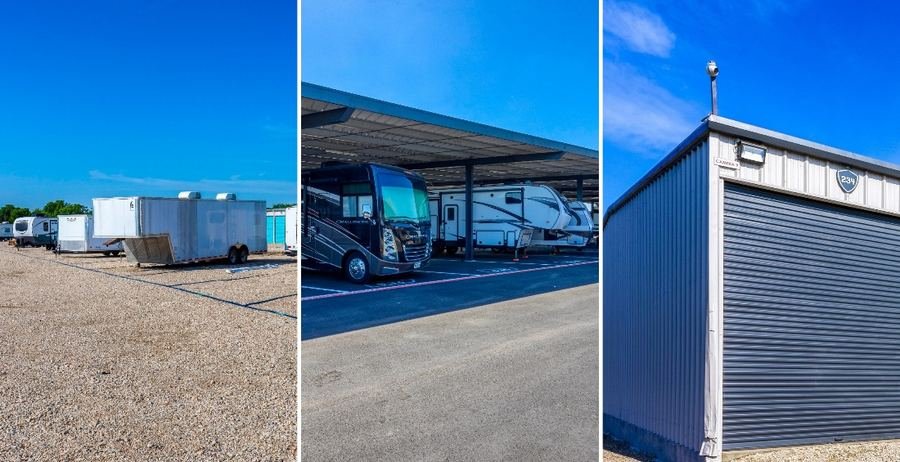
Because enclosed storage is competitively priced in the DFW market, the crossover point where enclosed becomes the lower total-cost option is just $50,400 in vehicle value. That's significantly lower than in many other markets and means enclosed already wins for virtually everyone storing in this market.
Carefree Covered RV Storage, Wylie, TX (3830 Parker Rd) — 30 to 36-foot spaces:
Uncovered (12' x 30'): $99/month = $1,188/year
Covered (12' x 35'): $189/month = $2,268/year
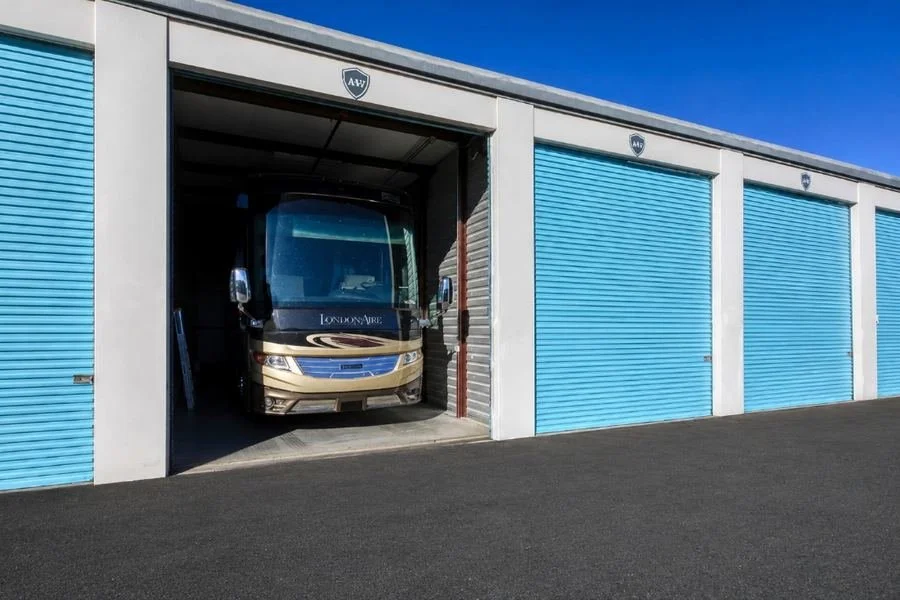
Enclosed (12' x 36'): $399/month = $4,788/year
Annual Cost Comparison: $100,000 Vehicle
| Storage Type | Annual Storage | Depreciation Rate | Annual Depr. $ | Total Annual Cost |
|---|---|---|---|---|
| Uncovered | $1,188 | 15% | $15,000 | $16,188 |
| Covered | $2,268 | 10% | $10,000 | $12,268 |
| Enclosed | $4,788 | 5% | $5,000 | $9,788 |
On a $100,000 vehicle, enclosed storage costs $2,480 less per year than covered and $6,400 less per year than uncovered. The highest monthly rate produces the lowest annual cost.
The Crossover Points in the DFW Market
Covered beats uncovered at approximately $21,600 vehicle value — essentially any vehicle worth storing.
Enclosed beats covered at approximately $50,400 vehicle value. If your vehicle is worth more than $50,400, enclosed is already the more economical choice on total annual cost, before any weather events are considered.
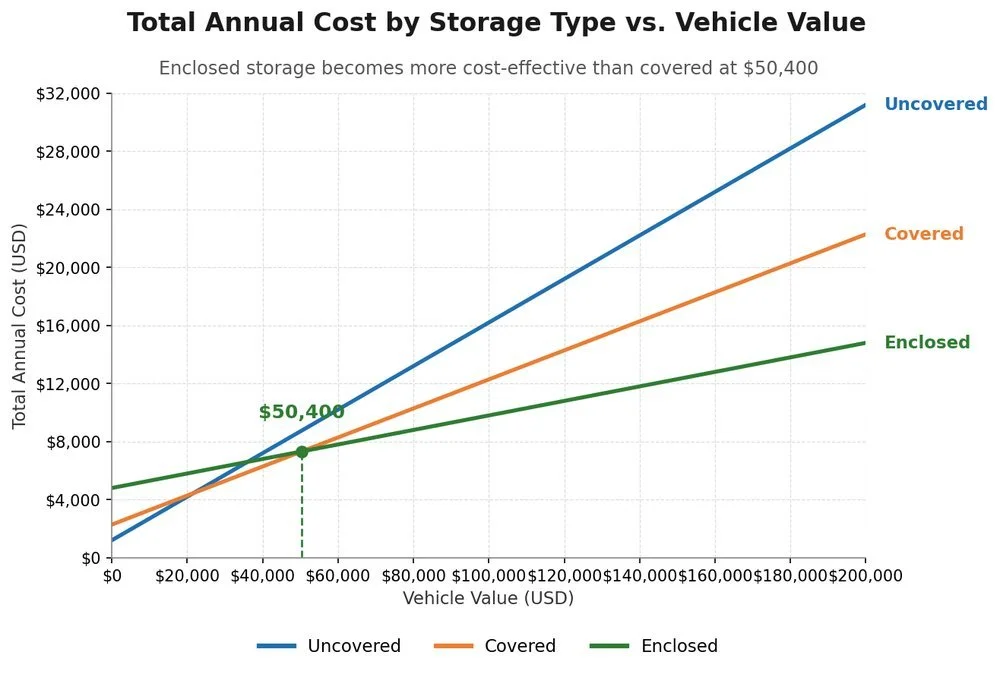
The $50,400 threshold is lower than many people expect, and lower than the equivalent threshold in other markets like Phoenix, where it sits closer to $78,000. This is because enclosed storage is priced competitively in the DFW market. If your vehicle is worth more than $50,400 — and most vehicles stored here are — enclosed storage is already the more economical choice on a total annual cost basis, before any weather events are considered.
Full Value Scenario Table: $50K to $800K
Enclosed storage wins at every price point in this table from $75,000 up. At $50,000, covered is now marginally cheaper by about $20, reflecting the new $50,400 crossover point. The green highlights tell the story.
| Vehicle Value | Uncovered Total | Covered Total | Enclosed Total |
|---|---|---|---|
| $50,000 | $8,688 | $7,268 | $7,288 |
| $75,000 | $12,438 | $9,768 | $8,538 |
| $100,000 | $16,188 | $12,268 | $9,788 |
| $150,000 | $23,688 | $17,268 | $12,288 |
| $200,000 | $31,188 | $22,268 | $14,788 |
| $300,000 | $46,188 | $32,268 | $19,788 |
| $400,000 | $61,188 | $42,268 | $24,788 |
| $500,000 | $76,188 | $52,268 | $29,788 |
| $600,000 | $91,188 | $62,268 | $34,788 |
| $700,000 | $106,188 | $72,268 | $39,788 |
| $800,000 | $121,188 | $82,268 | $44,788 |
As vehicle value increases, the depreciation savings from enclosed storage grow faster than the premium over covered or uncovered. The math becomes more compelling with every dollar of vehicle value.
What This Means Before Hail Season
- Enclosed RV storage costs less per year than covered storage for any vehicle worth more than approximately $50,400 — which includes almost every RV, motorhome, boat, or trailer stored in this market.
- A single significant hail event can cause more damage than years of the premium between covered and enclosed storage.
- DFW's combination of hail, humidity, heat, and severe spring storms creates more varied exposure risk than most other major markets.
- The monthly rate difference between covered and enclosed in DFW is roughly $210 — less than most people spend on a single tank of diesel.
- The higher the vehicle value, the larger the annual savings from enclosed: on a $200,000 vehicle, enclosed saves $7,480 per year compared to covered.
Find RV and Boat Storage Near You in DFW
Three storage facilities on Parker Rd in Wylie serve the DFW market — two Carefree locations and Wylie Bargain Storage & RV, which is operated by the same ownership group. All three offer a range of storage types, and all three are included here so you can find the right option closest to you.
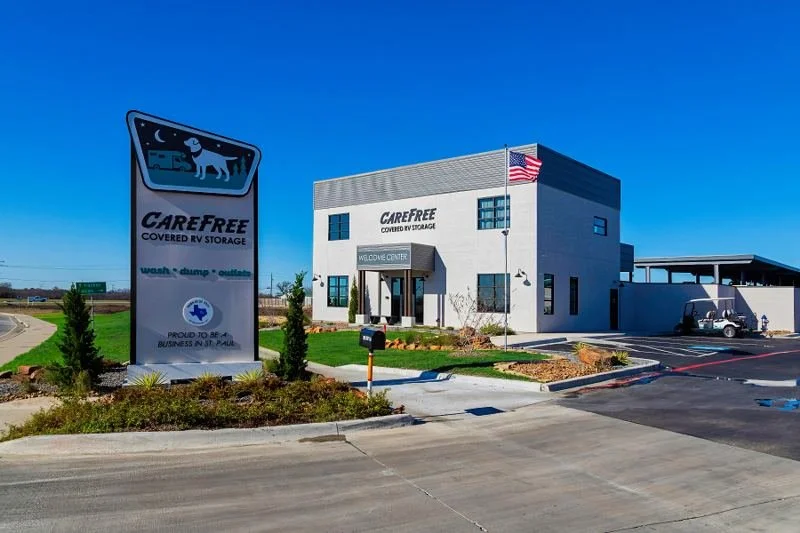
3830 Parker Rd — Enclosed, Covered & Uncovered
Phone: (469) 520-6210
Address: 3830 Parker Rd, Wylie, TX 75098
VIEW RATES & AVAILABILITY1405 Parker Rd — Covered & Uncovered
Phone: (972) 213-6214
Address: 1405 Parker Rd, Wylie, TX 75098
VIEW RATES & AVAILABILITY3151 Parker Rd (Wylie Bargain Storage & RV) — Enclosed, Covered & Uncovered
Phone: (972) 442-6747
Address: 3151 Parker Rd, Wylie, TX 75098
VIEW RATES & AVAILABILITYDisclaimer: Depreciation estimates in this article are based on general market data and DFW-area climate conditions. Actual depreciation varies by vehicle age, brand, condition, and market conditions. Storage rates are current as of publication and subject to change. Consult current listings for up-to-date pricing.