Covered RV Storage Arizona: When Does Enclosed Make More Sense?
When Does It Make Sense to Pay More for Covered or Enclosed RV Storage in Arizona?
What Five Arizona Summers Do to Your RV's Value
Short answer: covered storage beats leaving an RV or boat uncovered once it's worth more than roughly $20,400. In the Phoenix metro's extreme sun, enclosed storage takes over as the better value once that same vehicle crosses roughly $78,000. Here's why Arizona's UV exposure makes that gap wider than almost anywhere else, with real Chandler, AZ pricing behind the numbers.
Arizona has one of the highest UV indices in North America. For months at a time, the Phoenix metro regularly records UV index readings above 11, the threshold the National Weather Service classifies as extreme. Most RV owners think about storage cost in monthly terms: what does a spot cost per month, and is it worth it?
The more relevant unit is years. The cost of UV exposure in Arizona compounds over time in ways that consistently dwarf the monthly rate difference between storage options. A vehicle stored uncovered in Phoenix does not simply lose a bit of shine; it undergoes a slow, compounding process of material degradation that translates directly into resale value loss.
This article works through the numbers methodically, using real storage rates from the Phoenix metro market and realistic depreciation assumptions tied to storage type. The goal is to give Phoenix-area RV owners a clear picture of what each storage decision actually costs over five years.
Not sure what your RV or boat is worth?
Check jdpower.com/rvs for RVs, motorhomes, and trailers, or jdpower.com/boats for boats — both free and updated regularly. Cross-check against active listings on rvtrader.com or boattrader.com to see real market prices.
Your vehicle's current value determines which storage option makes financial sense for you.
What Arizona Sun Does to a Stored Vehicle
This is not a generic list of weather concerns. Each item below is specific to the conditions a stored RV faces in Phoenix and the surrounding metro area.
UV Oxidation: Clearcoat Failure, Paint Chalking, and Fading
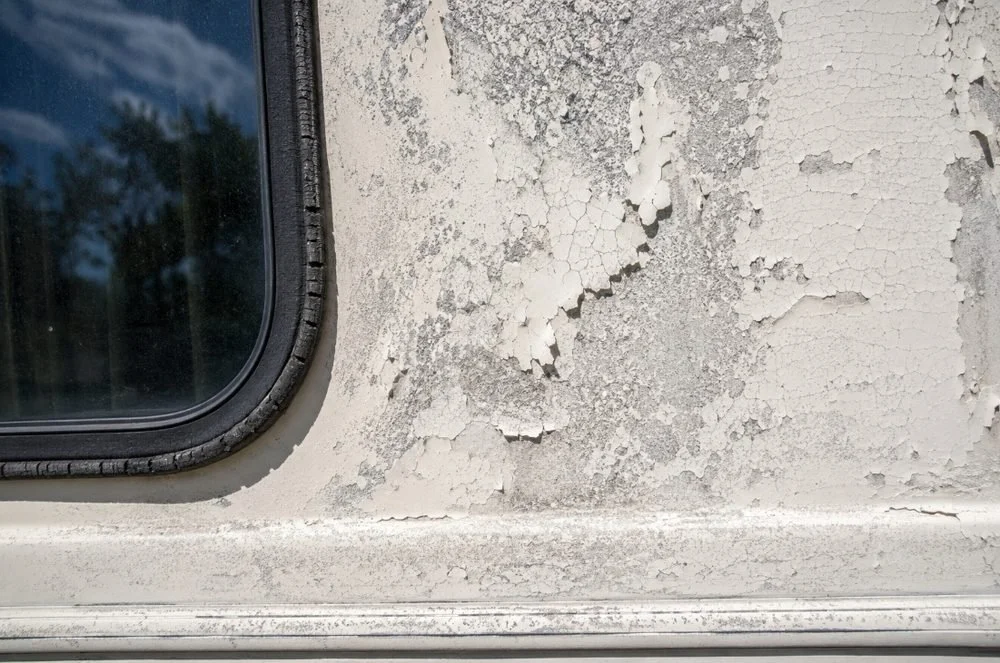
With a UV index above 11 for extended stretches of the year, Phoenix delivers more cumulative UV radiation than most North American climates. For an RV stored outside, this means continuous attack on painted and gel-coat surfaces. Clearcoat begins to fail within a few seasons; paint oxidizes and chalks; colors fade unevenly. Restoration is costly. Prevention is not.
Rubber Seal Degradation
Roof seams, slide-out seals, and window gaskets are the first line of defense against water intrusion. Under sustained UV exposure and the 150°F-plus interior temperatures common in Phoenix-area vehicles stored in direct sun, rubber compounds crack and shrink far faster than in milder climates. A compromised roof seal does not announce itself; it waits for the summer monsoon.
Interior Heat Damage
RV interiors under direct Arizona sun routinely reach 150 to 160°F. At those temperatures, upholstery fades and cracks, plastics warp and deform, electronics sustain heat stress, and cabinet laminate adhesives fail. These are not cosmetic issues; they reduce the functional value and resale appeal of the unit substantially.
Fiberglass Sidewall Delamination
Delamination, in which the fiberglass outer skin separates from the foam core of the sidewall, accelerates in high-heat environments. Once it starts, it spreads. Repair is expensive and rarely invisible. Enclosed storage, which keeps ambient temperatures significantly lower, substantially reduces delamination risk.
Arizona Summer Monsoon
Phoenix's monsoon season (typically July through September) brings brief but intense rain events that can drop significant rainfall in a very short window. Any seal that has been weakened by the preceding months of UV and heat becomes a point of failure. Covered storage protects against direct overhead rain; enclosed storage eliminates rain exposure entirely.
Covered storage blocks the worst of the overhead UV exposure and keeps direct rain off the roof. Enclosed storage is the only option that eliminates all of these exposure vectors entirely.
Three Storage Options, Three Outcomes
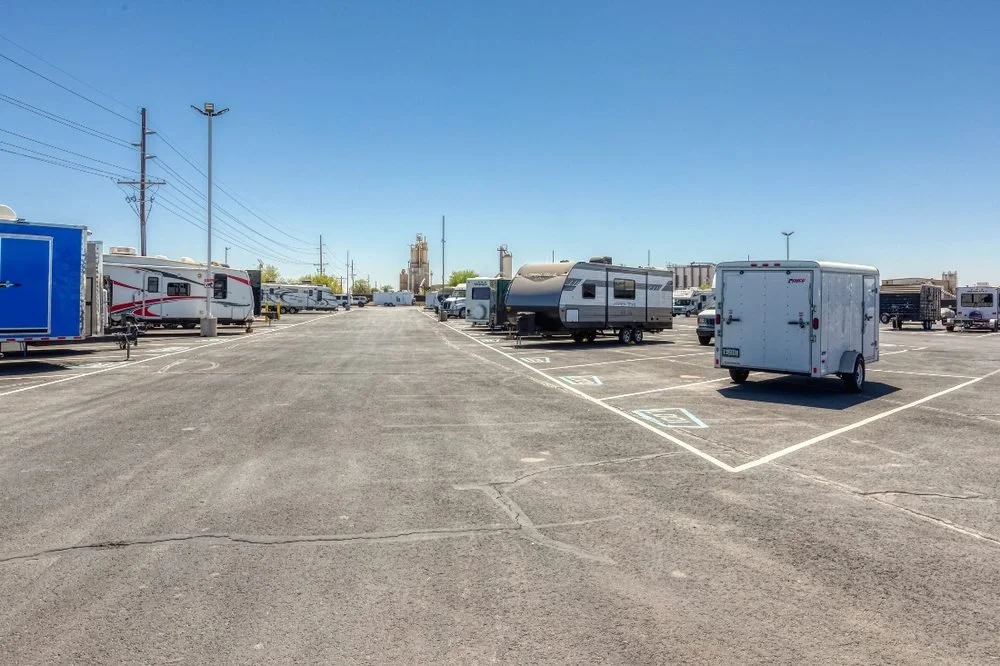
Uncovered Storage
The vehicle sits on an open lot. No protection from UV, heat, rain, or wind-driven debris. The lowest monthly rate. Depreciation proceeds at the fastest rate.
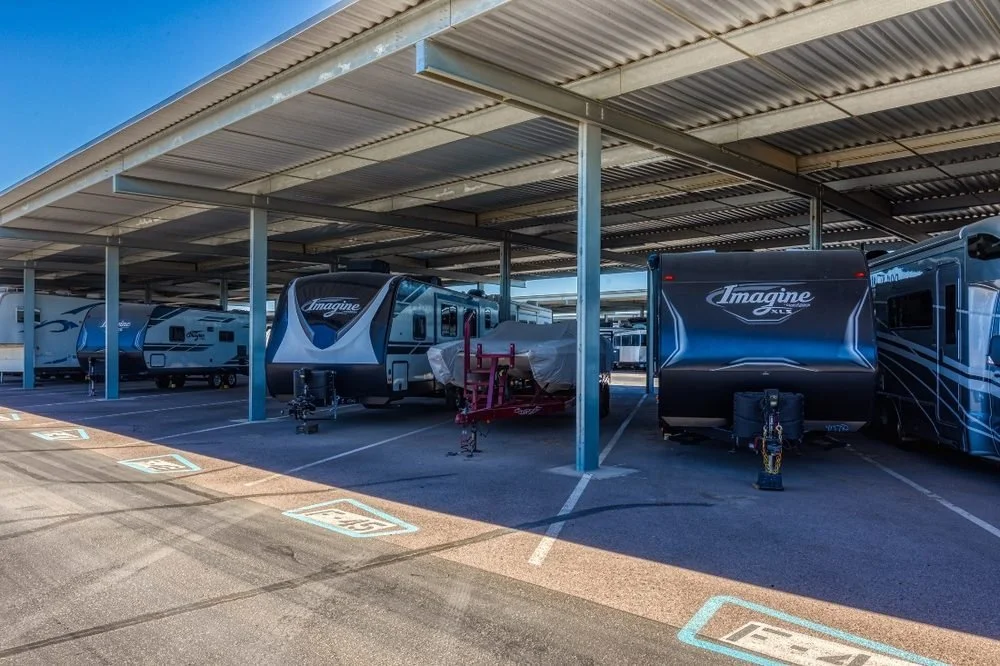
Covered Storage
A roof (typically a metal carport structure) provides overhead protection. Direct sun on the roof is blocked; ambient UV and side exposure remain. Interior temperatures are meaningfully lower than uncovered. Rain is kept off the roof. A substantial improvement over uncovered at a moderate price premium.
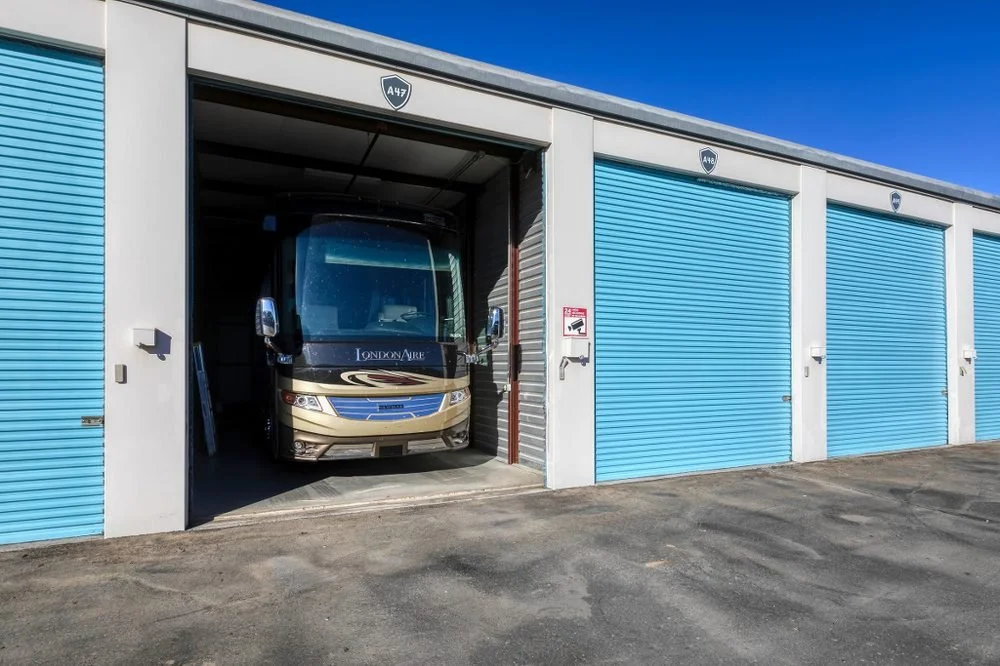
Enclosed Storage
Four walls and a roof. UV exposure is eliminated. Interior temperatures stay near ambient air temperature. Rain, wind, and debris cannot reach the vehicle. The highest monthly rate and the best preservation outcome, particularly for high-value units in extreme climates like Phoenix.
Depreciation Rates by Vehicle Type
The table below shows estimated annual depreciation rates by vehicle type, comparing the general market range to Phoenix-area estimates by storage type. Arizona's climate makes the gap between storage options more pronounced than milder markets.
| Vehicle Type | Typical Range | Uncovered (est.) | Covered (est.) | Enclosed (est.) |
|---|---|---|---|---|
| Travel Trailer | 8-12%/yr | 12-15% | 8-10% | 5-7% |
| Fifth Wheel | 8-12%/yr | 12-15% | 8-10% | 5-7% |
| Class A Motorhome | 10-15%/yr | 13-17% | 9-12% | 5-8% |
| Class B (Van) | 8-12%/yr | 11-14% | 7-10% | 4-7% |
| Class C Motorhome | 10-14%/yr | 12-16% | 8-11% | 5-8% |
| Toy Hauler | 10-15%/yr | 13-17% | 9-12% | 5-8% |
| Boat | 10-15%/yr | 12-18% | 8-12% | 4-7% |
For the calculations in this article, the following assumptions are used: 15% annual depreciation for uncovered storage, 10% for covered, and 5% for enclosed. These represent middle-of-range estimates consistent with Phoenix-area conditions.
The Five-Year Picture
Annual comparisons tell part of the story. What makes the Phoenix case compelling is how these rates compound. Each year of UV exposure does not just cost money in isolation; it reduces the base value that next year's depreciation applies to. Here is what that looks like over five years for two common vehicle value points.
$100,000 Vehicle — 5-Year Value Retention
| Year | Starting Value | Uncovered (15%/yr) | Covered (10%/yr) | Enclosed (5%/yr) |
|---|---|---|---|---|
| 0 | $100,000 | $100,000 | $100,000 | $100,000 |
| 1 | $85,000 | $90,000 | $95,000 | |
| 2 | $72,250 | $81,000 | $90,250 | |
| 3 | $61,413 | $72,900 | $85,738 | |
| 4 | $52,201 | $65,610 | $81,451 | |
| 5 | $44,371 | $59,049 | $77,378 |
After 5 years on a $100,000 vehicle:
Uncovered: $55,629 in value lost + $8,400 in storage = $64,029 total cost
Covered: $40,951 in value lost + $13,500 in storage = $54,451 total cost
Enclosed: $22,622 in value lost + $33,000 in storage = $55,622 total cost
At a $100,000 vehicle value, covered and enclosed come out nearly equal over five years. The case for enclosed storage grows stronger as vehicle value increases.
$200,000 Vehicle — 5-Year Value Retention
| Year | Starting Value | Uncovered (15%/yr) | Covered (10%/yr) | Enclosed (5%/yr) |
|---|---|---|---|---|
| 0 | $200,000 | $200,000 | $200,000 | $200,000 |
| 1 | $170,000 | $180,000 | $190,000 | |
| 2 | $144,500 | $162,000 | $180,500 | |
| 3 | $122,825 | $145,800 | $171,475 | |
| 4 | $104,401 | $131,220 | $162,901 | |
| 5 | $88,741 | $118,098 | $154,756 |
After 5 years on a $200,000 vehicle:
Uncovered: $111,259 in value lost + $8,400 in storage = $119,659 total cost
Covered: $81,902 in value lost + $13,500 in storage = $95,402 total cost
Enclosed: $45,244 in value lost + $33,000 in storage = $78,244 total cost
Enclosed saves $17,158 vs. covered and $41,415 vs. uncovered over five years on a $200,000 vehicle.
The Annual Numbers: Phoenix Metro Rates
Here is what the annual math looks like using real rates from a Carefree Covered RV Storage facility in Chandler, which is representative of the Phoenix metro market for this size range.
Chandler Facility Rates (35-foot spaces):
Uncovered (12x35 ft): $140/month = $1,680/year
Covered (12x35 ft): $225/month = $2,700/year
Enclosed (15x34 ft): $550/month = $6,600/year
Annual Cost Comparison: $100,000 Vehicle
| Storage Type | Annual Storage | Depr. Rate | Annual Depr. $ | Total Annual Cost |
|---|---|---|---|---|
| Uncovered | $1,680 | 15% | $15,000 | $16,680 |
| Covered | $2,700 | 10% | $10,000 | $12,700 |
| Enclosed | $6,600 | 5% | $5,000 | $11,600 |
For a $100,000 vehicle, enclosed storage produces the lowest total annual cost at $11,600, compared to $12,700 for covered and $16,680 for uncovered.
Crossover Points
Covered beats uncovered at approximately $20,400 vehicle value. Below that threshold, the storage cost premium for covered exceeds the depreciation savings. Above it, covered storage pays for itself in preserved value.
Enclosed beats covered at approximately $78,000 vehicle value. For owners of motorhomes, fifth wheels, and Class A units, the breakeven for enclosed storage typically falls well below the vehicle's market value.
Full Value Scenario Table: $50,000 to $800,000
The table below calculates the total annual cost (storage plus depreciation) for vehicle values from $50,000 to $800,000, using the Chandler facility rates and the depreciation assumptions above. The lowest total cost in each row is highlighted in green.
| Vehicle Value | Uncovered Total | Covered Total | Enclosed Total |
|---|---|---|---|
| $50,000 | $9,180 | $7,700 | $9,100 |
| $75,000 | $12,930 | $10,200 | $10,350 |
| $100,000 | $16,680 | $12,700 | $11,600 |
| $150,000 | $24,180 | $17,700 | $14,100 |
| $200,000 | $31,680 | $22,700 | $16,600 |
| $300,000 | $46,680 | $32,700 | $21,600 |
| $400,000 | $61,680 | $42,700 | $26,600 |
| $500,000 | $76,680 | $52,700 | $31,600 |
| $600,000 | $91,680 | $62,700 | $36,600 |
| $700,000 | $106,680 | $72,700 | $41,600 |
| $800,000 | $121,680 | $82,700 | $46,600 |
As vehicle value increases, the depreciation component grows faster than the storage cost premium. For high-value units, the storage cost difference between uncovered and enclosed becomes a rounding error relative to the depreciation savings.
Key Takeaways for Phoenix-Area RV Owners
- For any vehicle worth more than approximately $20,400: covered storage beats uncovered on total annual cost. The storage premium is more than offset by the depreciation savings.
- For any vehicle worth more than approximately $78,000: enclosed storage beats covered on total annual cost. Most motorhomes, fifth wheels, and Class A units fall well above this threshold.
- Over five years, the compounding gap becomes substantial. On a $200,000 vehicle, enclosed storage saves more than $17,000 compared to covered and more than $41,000 compared to uncovered.
- Arizona's UV conditions are among the most damaging in North America for stored vehicles. The depreciation differential between storage types is more pronounced in Phoenix than in virtually any other major metro market.
- The cheapest monthly option is consistently the most expensive when total cost (storage fees plus depreciation) is calculated. This is true for any vehicle worth more than $20,400.
Find Storage Near You in the Phoenix Metro
Carefree Covered RV Storage operates facilities across the Phoenix metro area offering uncovered, covered, and enclosed storage for RVs, boats, motorhomes, toy haulers, and trailers in a range of sizes. Two facilities are located in Chandler, both offering all three storage types.
Whether you own a Class A coach, a toy hauler, a fifth wheel, or a boat, the right storage option in Phoenix is the one that accounts for the full cost of ownership over time, not just the monthly rate.
1575 S. Nelson Dr., Chandler — Enclosed, Covered & Uncovered
Phone: (480) 488-9504
Address: 1575 S. Nelson Dr., Chandler, AZ 85226
VIEW RATES & AVAILABILITY1000 S. Kyrene Rd., Chandler — Enclosed, Covered & Uncovered
Phone: (480) 789-1554
Address: 1000 S. Kyrene Rd., Chandler, AZ 85226
VIEW RATES & AVAILABILITYCarefree also has a fully enclosed garage location in Apache Junction. Its unit doors are smaller than the Chandler facilities' — built for cars, trucks, motorcycles, and specialty vehicles rather than RVs or boats:
535 E. 37th Ave., Apache Junction — Enclosed Auto, Truck & Specialty Vehicle Garage
Phone: (480) 983-7600
Address: 535 E. 37th Ave., Apache Junction, AZ 85119
This location's enclosed units are sized for cars, trucks, motorcycles, and specialty vehicles, not RVs or boats. Apache Junction also has separate covered RV parking on-site; contact the facility directly for that option.
VIEW RATES & AVAILABILITYCarefree also operates Phoenix-area facilities in San Tan Valley, Surprise, and Maricopa. View all locations and rates.
Note: Depreciation estimates in this article are based on general market data and Phoenix-area climate conditions. Actual depreciation varies by vehicle age, brand, condition, and market conditions. Storage rates are current as of publication and subject to change. Consult current listings for up-to-date pricing.